
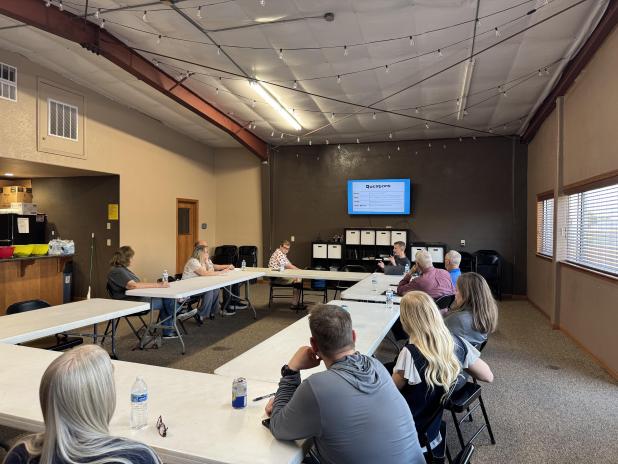
PCCFF Hometown Intern Brock Tines speaks to a group of citizens who gathered last week to discuss the possibility of establishing a community center in Grant.
Residents share vision for possible community center in Grant
The Perkins County Community Foundation Fund hosted a second community conversation on Thursday, July 30 at the E-Free Church’s Youth building to continue discussing what a future community center in Grant could look like, with ideas ranging from indoor recreation and youth activities to meeting space, daycare and walking tracks. Several community members participated in the meeting, including representatives from the City of Grant and the Perkins County Commissioners.
The community conversation, led by Brock Tines, Hometown Summer Intern for the Perkins County Community Foundation Fund, was designed to gather public input on whether a community center would benefit Perkins County and what amenities residents would like to see included.
Tines said the idea grew out of an initial community conversation visioning session held earlier this summer in which residents were asked what projects would help make Perkins County an even better place to live and attract new families.
“The main thing that we heard was a community center,” Tines told those attending.
“We’re here to learn what that would look like, whether it would be beneficial, and how we could make something like that happen.”
Focus on recreation and youth
Several participants emphasized the need for more year-round recreational opportunities, particularly during the winter months.
Suggestions included:
• An indoor gymnasium for basketball, volleyball and pickleball.
• An indoor walking track.
• Dedicated space for teenagers to gather.
• Indoor playground equipment for younger children.
• Small meeting rooms for birthday parties, graduations and family gatherings.
• Space that could accommodate educational programs, performances and community events.
Residents noted that while Grant has facilities for large receptions and community events, there are fewer options for recreation and casual gathering spaces available to all ages.
One attendee described a community center as a valuable “third space”—a place outside of home and work where residents can gather without needing to spend money.
Daycare identified as community need
Another recurring theme was the shortage of childcare. Several attendees suggested incorporating daycare into a future facility or creating space that could support multiple childcare providers working together under one roof. Others noted that expanded childcare could benefit local employers by helping recruit and retain workers.
Existing buildings vs. new construction
Discussion also centered on whether an existing downtown building should be renovated for the center or if a new facility should be constructed. Some residents favored repurposing vacant buildings on Central Ave., while others pointed out that renovation costs can often exceed new construction. Parking, accessibility and available grant funding were also discussed as factors that would influence the decision.
Looking at other Nebraska communities
To help spark ideas, Tines shared examples of community centers in Arnold and Byron. He noted that Arnold, with a population of roughly 600 people, successfully built a community center that includes recreational space, meeting rooms and a kitchen. Byron, with fewer than 100 residents, also operates a community center.
“The size of a town shouldn’t determine whether something is possible,” Tines said during the discussion.
Preliminary floor plan presented
Maddie Wood, who is a graduate of the University of Nebraska at Kearney with training in interior and product design, presented a conceptual floor plan she developed at Tines’ request, which she presented to the group.
The preliminary sketch featured:
• A large recreation area.
• Flexible meeting and event rooms.
• A kitchen.
• Restrooms.
• Space that could be adapted as community needs evolve.
She emphasized that the drawing was only intended to start conversation and could change significantly as public input continues.
Participants also made other potential suggestions, including:
• An elevated indoor walking track.
• Modular walls that could divide larger rooms.
• Outdoor basketball courts and playgrounds.
• Gazebos.
• Storm shelter capabilities.
• Showers for emergency use.
• Key-card access and security cameras.
Funding and management
Participants discussed how a community center might be operated and funded. Ideas included management through the city, a nonprofit organization or a community board. Rental fees for meeting rooms and special events were suggested as one way to help offset operating expenses.
Tines shared examples from other communities that use reservation systems, rental agreements and security deposits while relying on volunteer oversight rather than full-time staffing.
Several grant opportunities, including state and federal programs supporting community facilities and downtown revitalization, were also mentioned as potential funding sources.
More public input planned
Meeting participants encouraged Tines to continue surveying residents and to seek additional feedback from youth, families and community organizations. Tines planned to seek invested individuals to organize a steering committee to continue researching and implementing the project. He will give updates on the process as needed.
For more information, or to be part of the steering committee for a new community center, email Brock Tines at btines@nebcommfound.org, or any PCCFF member.