
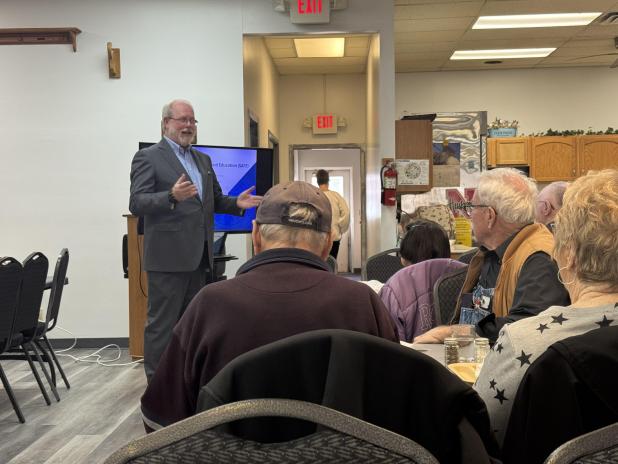
Ryan Sothan, outreach coordinator with the Nebraska Attorney General’s Office, speaks to a group at the Perkins County Senior Center on Feb. 10 about increasing fraud risks and how to avoid them.
Grant seniors learn how to spot scams at fraud education session
With scam calls, data breaches, and online fraud on the rise, local residents gathered at the Perkins County Senior Center on Feb. 10 for a fraud education session led by Ryan Sothan, outreach coordinator with the Nebraska Attorney General’s Office.
Sothan described his mission as “connecting and protecting” Nebraskans by traveling the state’s 93 counties to teach people how to recognize and report fraud. He highlighted the office’s Consumer Protection Division and Consumer Affairs Response Team (CART), which help Nebraskans resolve unfair or deceptive business practices free of charge.
Nebraska currently ranks 41st in the nation for fraud complaints per 100,000 residents, he said. While that appears relatively good, the state has moved from 47th to 41st in just two years, a sign that fraud is increasing, Sothan said. Sothan pointed to three major trends driving the problem: large-scale data breaches, misuse of artificial intelligence (AI) for fake voices and videos, and the growing role of cryptocurrency, especially through suspicious crypto ATMs.
Older adults are being deliberately targeted, Sothan said. Though Nebraskans 60 and older make up about a quarter of the population, they account for more than a third of fraud complaints. A major study of elder abuse found that actual fraud against seniors occurs at 44 times the rate that it is formally reported, suggesting most victims never tell authorities.
Sothan focused on imposter scams, in which criminals pose as such companies as Amazon, banks, delivery services, or government agencies such as Social Security and Medicare. He urged residents to watch for four red flags: 1) an unexpected caller claiming authority, 2) a dramatic story that stirs emotion, 3) pressure to act quickly, and 4) requests for unusual payment methods such as gift cards, digital payment apps, or cryptocurrency .
He also warned about romance scams, where scammers build online relationships and then ask for money, and about identity theft, which now represents a large share of complaints. His top protection tip was to place a credit freeze with the three major credit bureaus—Equifax, Experian, and TransUnion—so new accounts cannot be opened without the consumer’s approval.
To combat relentless robocalls, Sothan explained that federal law now requires phone companies to offer free call-blocking tools. Services such as Verizon Call Filter, AT&T ActiveArmor, and T-Mobile Scam Shield can help block fraudulent calls before they ever ring. He also showed attendees how to turn on settings like “Silence Unknown Callers” on smartphones and reminded them not to answer calls from unknown numbers labeled as suspected spam or scam.
Sothan encouraged anyone who suspects fraud to contact the Nebraska Attorney General’s Office at 402-471-2682, visit its consumer protection website at protectthegoodlife.nebraska.gov, or speak with a trusted friend or family member before sending money or sharing personal information.
“Don’t suffer in silence,” he told the group. “You’re not alone—and there are tools and people ready to help.”
He stayed after the presentation to answer questions and help attendees adjust settings on their phones.
Editor’s Note: This article was written with the assistance of AI, with oversight and editing done by Grant Tribune-Sentinel Staff.