
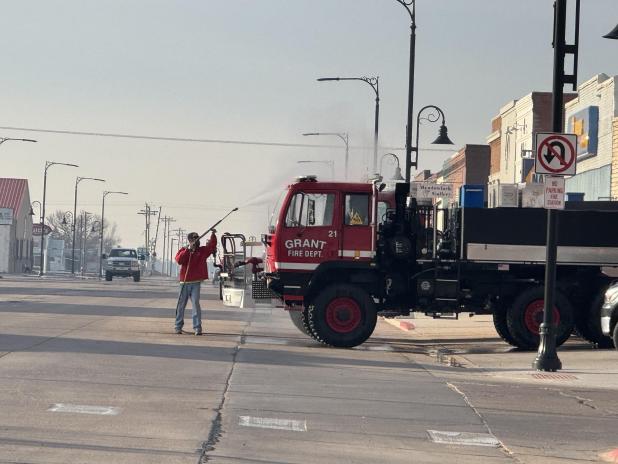
With smoke from the Morrill Fire hanging in the air, Grant firefighter Garrett Thompson washes one of the Grant Fire Department’s trucks Saturday morning, March 14, after a shift battling the blaze. According to Grant Fire Chief Don Softley, firefighters from the Grant Fire Department maintained two trucks on scene at all times, using a third truck and a command vehicle as needed. Crews typically rotated four-to six-person teams every 12 hours to keep fresh firefighters available on scene, he said.
Area firefighters among those responding to historic Morrill Fire, now largest fire ever recorded in NE history
BY BECKY UEHLING GRANT TRIBUNE Correspondent
With reporting from Jeff Headley, Keith County News
As the largest wildfire in Nebraska history tore across western Nebraska last week, area volunteer firefighters were among the many departments that helped battle the blaze, which as of Monday had consumed approximately 575,000 acres, according to officials.
Along its path, the blaze burned across miles of Nebraska prairie, destroying structures in some areas—including the home of Garden County Sheriff Randy Ross, whose family barely escaped—and forcing evacuations as residents moved out of the fire’s path.
The fire also claimed the life of Rose White of Arthur, who died while attempting to escape the fast-moving blaze, officials said.
The fire that started on Thursday, March 12 from what was believed to be an electrical issue north of Bridgeport in Morrill County, had grown “very little” Sunday as firefighters built fire lines and patrolled burned areas, officials said.
Fire raced across western Nebraska
Fueled by strong west winds reaching up to 50 mph, the fire moved rapidly east Thursday from Morrill County across Garden County and into Keith and Arthur counties.
Its path roughly paralleled Highway 26 before reaching the Lake McConaughy area, remaining north of Highway 92 before eventually pushing toward the north shore of the reservoir.
Ranch families found themselves moving livestock to safety while also trying to protect homes and outbuildings, many of them in the middle of calving season.
Evacuations occurred late in the week through Saturday in portions of Keith, Garden and Arthur counties. Many evacuations were relatively short-lived, considering the speed and scale of the fire, officials said.
Mutual aid from across the region
As the fire expanded, local resources were quickly stretched thin and mutual aid requests went out across the region.
In Keith County alone, officials said roughly 15 fire departments were called in to help battle the blaze, including Grant, Venango, Elsie, Madrid, Imperial, Wallace, and Phillips County departments, along with Keystone-Lemoyne, Ogallala, Paxton, Brule, Big Springs, Sutherland, Hershey, Lamar, Wauneta, Palisade and Stratton. Additional departments and strike teams were also mobilized as the fire continued to grow.
Heavy equipment supplied by county governments, private contractors and area ranchers also helped cut fire lines across the prairie in an effort to slow the advance of the flames, according to officials.
Incident management team assumes control
As the fire grew in size and complexity, additional state and federal resources were brought in to assist.
Governor Jim Pillen toured the affected areas by air on Saturday, March 14 along with Nebraska U.S. Senator Pete Ricketts and U.S. Congressman Adrian Smith before meeting with emergency officials at the Keith County Fairgrounds.
The governor described the destruction caused by the fire as “heart-breaking” and said the state would utilize all available resources to assist in the response.
State officials also authorized deployment of 26 Nebraska National Guard soldiers and airmen, along with aerial firefighting resources including helicopters capable of targeted bucket drops.
Road graders from the Nebraska Department of Transportation were also deployed to help build fire breaks around affected areas.
Following the initial response, the Rocky Mountain Complex Incident Management Team 1 (RMCIMT1), led by Incident Commander Justin Conrad, assumed command of the Morrill Fire and the Cottonwood Fire in Lincoln County Saturday evening.
These specialized teams are typically deployed when wildfires become too large or complex for local agencies to manage alone. The team includes personnel from several states including Colorado, Nebraska, South Dakota and Wyoming and includes specialists in operations, logistics, planning and public information.
The incident command center has been established at the Keith County Fairgrounds, where crews and supplies are being coordinated.
Cottonwood Fire also burning
While the Morrill Fire has drawn the most attention, firefighters are also battling the nearby Cottonwood Fire, which has burned approximately 122,144 acres south of Interstate 80 in Lincoln County.
According to a Monday morning update from the RMCIMT1, crews worked Sunday to keep fire activity minimal on the north and south areas of the Cottonwood Fire, while night crews monitored activity near the Jeffrey Lake area.
According to the RMCIMT1 report, fires remained 0 percent contained Monday morning, though firefighters reported little fire activity along many sections of the perimeter as they continued building firelines and conducting mop-up operations.
Four Black Hawk helicopters were expected to assist with firefighting operations Monday, according to the RMCIMT1 report.
Perkins County crews rotate through response
According to Venango Fire Chief Steve Tucker, firefighters from the Perkins County departments rotated crews into the fire zone for nearly two days as the blaze spread across the region.
Because of the size of the incident, firefighters and equipment were continually rotated in and out as departments tried to keep crews rested while maintaining manpower on the lines, he said.
“We just kept sending crews back and forth,” Tucker said. “It was constantly changing depending on where the fire was moving.”
Crews from the local departments worked both day and night shifts in areas north of Highway 61 and in portions of Keith and Garden counties, he said.
Tucker said he estimates around 30 firefighters from Perkins County participated in the response, though exact numbers will not be finalized until departments complete their reports.
To prevent exhaustion during the extended response, officials attempted to keep firefighters working no more than 12-hour shifts before rotating them out, Tucker said.
According to Grant Fire Chief Don Softley, firefighters from the Grant Fire Department maintained two trucks on scene at all times, using a third truck and a command vehicle as needed. Crews typically rotated four- to six-person teams to keep fresh firefighters available on scene, Softley said.
Grant also had an ambulance on location during the first 24 hours, and later had crews placed on standby for several additional hours, Softley said.
Softley said Perkins County departments were released from the incident around 6 p.m. Sunday evening, after having personnel working the fire since approximately 9 p.m. Thursday night.
Departments are now cleaning equipment, servicing trucks and preparing for future calls, Tucker said.
Supporting aircraft operations and weather challenges
In addition to fighting fire on the ground, Perkins County departments also helped support aerial firefighting efforts, Tucker said.
Grant firefighters assisted operations at the Ogallala airport, where aircraft used for wildfire suppression were refilled before returning to the fire zone. Water trucks were used to pump water directly into aircraft tanks as part of the operation, Tucker said.
Some aircraft operations later shifted to the Oshkosh airport as firefighting resources were repositioned across the region. High winds at times also grounded aircraft that were assisting with aerial water drops.
Several area pilots also helped with fire suppression, according to officials from Wallace Aviation in Wallace.
Weather creates challenges
Wild swings in weather created additional challenges for firefighters working the blaze. Temperatures during the response ranged from daytime highs near 70 degrees to overnight lows that dropped to around six degrees. The sudden cold caused some equipment issues for local departments.
“We had some water lines freeze up,” Tucker said. “We had a connection freeze, but nothing major.”
The same system that brought colder temperatures also brought strong winds and even snow in some areas, with Tucker saying one Perkins County firefighter reporting encountering snowfall while battling the fire north of Oshkosh.
Community response
The overwhelming support from the public for responders was amazing, Tucker said.
Tucker said volunteers provided meals and supplies for firefighters at command centers in Ogallala and Oshkosh. Crews returning from long shifts had food ready and waiting, and he said firefighters never had to worry about basic needs. In some cases, support exceeded what was needed, highlighting the strong community backing for those on the front lines.
How to help
People who want to help those that have been affected by the fires have several organizations that are coordinating relief efforts for ranchers and families affected by the fires, with officials encouraging those who want to help to do so through organized channels.
Monetary donations can be made through the Nebraska Cattlemen Disaster Relief Fund at nebraskacattlemen.org or by contacting disasterrelief@necattlemen.org. Additional local relief efforts, including the Nebraska Sandhills Rancher Fire Relief, are also accepting donations through regional organizers. Donations of hay, fencing and livestock supplies are being coordinated through Ogallala Ag Supply and Ranch Supply in Hyannis, with donors asked to contact Patti Barnt at 308-280-0025 before delivering large loads. Those willing to assist with rebuilding efforts, including donating fencing materials, can contact local organizers, as efforts continue to support impacted producers.
Continue to watch the High Plains News newspapers for more information on this incident.