
AG Hilgers Highlights Legal Victories, ‘Winning’ Philosophy at Perkins County GOP Meeting
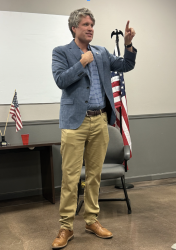
Nebraska Attorney General Mike Hilgers brought a straightforward message to members of the Perkins County Republican Party during its Sept. 29 meeting at Regier Equipment in Madrid: his office is not interested in simply managing the challenges facing Nebraska — it intends to win.
“I’m in the business of winning,” Hilgers told those gathered, explaining that his goal is not to merely “manage decline,” but to work with talented people willing to tackle difficult problems and accomplish big things.
That philosophy became a central theme of Hilgers’ remarks as he walked attendees through some of the major legal battles his office has undertaken — from Nebraska’s successful challenge to the Biden administration’s student-loan forgiveness program and its fight against California electric-truck mandates to ongoing litigation involving social media companies, alleged foreign influence in Nebraska elections and a major water-rights dispute with Colorado.
Voter Information and
Increasing Turnout
Before Hilgers addressed the group, Perkins County GOP Chairperson Melissa Sauder discussed the upcoming election and resources available to voters.
Sauder distributed voter guides provided by the Nebraska Republican Party listing Republican candidates appearing on the ballot. She also discussed judicial retention questions and said she planned to provide members with a judicial review resource compiling attorneys’ evaluations of judges, which she described as the only objective resource she had found for reviewing judicial performance.
The group also discussed four statewide ballot measures, including a proposal to extend legislative term limits from two terms to three, Measures 440 and 441 involving online sports betting, and a “fairness for girls” initiative.
Sauder noted that the party had no official position on the term-limit proposal.
Discussion among those attending included differing views on whether longer legislative terms could provide lawmakers with additional experience and reduce the influence of lobbyists, or whether extending terms would be preferable to the turnover created by the current limits.
Online sports betting also generated discussion, with concerns raised that legalization would essentially place a casino on every smartphone and could create additional risks, particularly for younger people.
Another topic was Voter Tree, a voter-turnout tool developed by Nebraska Secretary of State candidate Scott Petersen.
Sauder explained that Voter Tree allows users to organize people they know, review their voting history and identify individuals they can personally encourage to participate in the election.
The concept is to use existing relationships — friends, relatives, neighbors and other contacts — to increase voter participation rather than relying solely on traditional campaign outreach.
Sauder emphasized the importance of increasing Republican turnout in Nebraska’s Third Congressional District, noting that stronger participation in rural Nebraska increases the region’s political influence compared with the state’s more populated Omaha and Lincoln areas.
Following the local party business, attention turned to Hilgers and the work of the Nebraska Attorney General’s Office.
Building a Team Focused
on Winning
Hilgers, a Nebraska native and former Speaker of the Nebraska Legislature, spoke about his background in both business and government.
He described building his own law practice from a basement startup into a firm with approximately 120 attorneys over a 12-year period before bringing his experience to public service.
Hilgers said he has tried to bring that same entrepreneurial approach to the Attorney General’s Office.
His goal, he said, is to build the “best pound for pound law firm in the United States.”
With approximately 70 attorneys, the Nebraska Attorney General’s Office is relatively small compared with the federal government, large corporations and the legal operations of more populous states.
Hilgers argued that size does not determine the outcome.
Instead, he emphasized finding highly motivated attorneys willing to take on difficult cases and major opponents.
That philosophy led to one of the statements that stood out during his presentation.
Hilgers said he is in the business of “winning” for the State of Nebraska, not simply “managing decline,” and wants to work with great people capable of accomplishing big things.
Taking Federal Power to the Supreme Court
One of the most prominent victories highlighted by Hilgers was Biden v. Nebraska, the challenge to the Biden administration’s plan to cancel hundreds of billions of dollars in federal student-loan debt.
Hilgers framed the case as being about more than student loans.
At its core, he said, the question was whether the executive branch could authorize spending on such a massive scale without approval from Congress.
Nebraska and other states challenged the program, and the U.S. Supreme Court ultimately sided with the states in 2023, blocking the administration’s plan.
Hilgers cited the decision as an important victory for the constitutional separation of powers, arguing that spending of that magnitude requires congressional authorization.
His office has taken a similar approach to federal environmental regulations.
Hilgers discussed successful legal challenges involving federal power-plant regulations as well as the expanded Waters of the United States, or WOTUS, rule, which he said could have subjected relatively minor waterways and drainage areas on private property to federal regulation.
Taking on California and New York
Hilgers also highlighted Nebraska’s involvement in legal challenges against policies originating in other states that could have consequences far beyond their borders.
One example involved California regulations intended to transition heavy-duty trucking fleets toward electric vehicles.
Nebraska led a coalition of 18 states challenging California’s mandate. Hilgers argued that because so many trucking companies operate across state lines, California could effectively influence national trucking policy by imposing requirements on carriers doing business there. During the Perkins County meeting, Hilgers described California’s electric-truck mandate as one of the “dumbest ideas” he had encountered.
The legal challenge ultimately resulted in California repealing the rule, according to Hilgers.
Hilgers also discussed litigation involving New York and other states seeking to impose more than $100 billion in assessments against fossil-fuel companies.
Nebraska joined litigation challenging those efforts, with Hilgers reporting that a court order stopped the measures.
For Nebraska, Hilgers portrayed both battles as examples of policies originating elsewhere that could ultimately affect the cost of transportation, energy and other necessities for Nebraskans.
Confronting Corporate Power
Hilgers told attendees that government is not the only source of concentrated power his office is willing to challenge.
He discussed efforts involving some of the world’s largest banks and insurance companies and their participation in “net zero” climate alliances.
Hilgers said those organizations sought to use their collective market influence to move away from fossil fuels by 2050.
A coalition of attorneys general challenged those arrangements, and Hilgers said pressure from the states resulted in financial institutions backing away from the alliances.
Hilgers devoted particular attention to his office’s legal battles involving technology companies and their impact on children.
Big Tech and Protecting Children
Nebraska has filed litigation against TikTok over practices the state alleges are harmful to children.
Hilgers described an investigation in which accounts were created to represent 10-year-old girls. According to his presentation, those accounts were quickly presented with disturbing content involving sexual abuse, drug use and suicide.
He also told attendees Nebraska ranks second nationally for underage TikTok use between midnight and 4 a.m.
The state is seeking substantial damages in the litigation, which remains ongoing.
Nebraska has also filed a lawsuit against Roblox.
Hilgers said investigators found games on the platform that allowed users to simulate school shootings and visit a virtual representation of Jeffrey Epstein’s island.
Those allegations are part of ongoing litigation and have not yet received a final judicial determination.
The cases follow a landmark settlement involving Meta, parent company of Facebook and Instagram.
Nebraska will receive up to $201 million as part of a $17.1 billion settlement involving 47 states, the District of Columbia and U.S. territories over claims that Meta knowingly designed and deployed harmful features on its social media platforms that could addict children and teens.
The settlement also requires significant changes for younger Facebook and Instagram users, including a combined two-hour daily time limit and mandatory pauses after periods of continuous use. Children will also be blocked from accessing the platforms between midnight and 6 a.m., with limited access and no push notifications on weekdays from 8 a.m. to 3 p.m. during the school year.
Additional provisions include stronger age-verification measures, age-appropriate content controls and expanded parental controls. Most of those protections are expected to remain in effect for 10 years.
Hilgers described the settlement during the Perkins County meeting as one of his office’s significant victories in its broader effort to hold technology companies accountable for their impact on children.
Nebraska’s Water Battle With Colorado
For western Nebraska, one of the cases with potentially significant long-term implications is Nebraska’s legal battle with Colorado over the South Platte River.
Nebraska has taken its dispute directly to the U.S. Supreme Court, accusing Colorado of violating Nebraska’s rights under the century-old South Platte River Compact.
The dispute is closely connected to Nebraska’s plans for the Perkins County Canal and the state’s ability to secure water flowing from Colorado into Nebraska.
The approximately 100-year-old compact provides Nebraska with certain rights involving South Platte River water, including eminent-domain provisions in Colorado.
Hilgers told attendees that after Colorado’s Attorney General indicated the state was prepared to keep Nebraska tied up in lower courts for years, Nebraska took the unusual step of filing its case directly with the U.S. Supreme Court.
The Supreme Court agreed to hear Nebraska’s case.
Hilgers cautioned that the litigation could take four or five years but made clear that his office considers Nebraska’s long-term water rights worth fighting for.
For agricultural communities across western Nebraska, the eventual outcome could carry consequences extending well beyond the current administration.
Foreign Money in
Nebraska Elections
Hilgers also discussed an ongoing case involving what his office alleges is foreign money flowing into Nebraska ballot initiatives.
According to Hilgers, an investigation traced approximately $10 million in funding associated with recent ballot initiatives to a Swiss billionaire.
The Attorney General’s Office filed litigation in Madison County alleging the funding violated Nebraska law governing foreign involvement in state elections.
Hilgers told those attending the Perkins County meeting that the case has moved into discovery.
Because the lawsuit remains pending, the allegations have not received a final judicial determination.
Hilgers characterized the issue as one of state sovereignty and whether decisions concerning Nebraska law should be influenced by money originating outside the United States.
Legal Battles Closer to Home
The Attorney General’s Office has also become involved in disputes involving Nebraska cities.
Hilgers discussed successful lawsuits against Lincoln and Omaha after the cities attempted to establish their own minimum-wage laws contrary to state statute.
He also highlighted a recent dispute in Lincoln after city officials sought to delay a vote on proposed charter amendments.
The Attorney General’s Office sued, and the Nebraska Supreme Court ultimately ordered the measures placed before voters.
Hilgers said the proposed changes included moving Lincoln mayoral elections to presidential election years, when voter turnout is higher.
The case, like many of the others Hilgers discussed, centered on what he views as a fundamental principle: government entities must operate within the authority provided to them by law.
“Winning” Rather Than
Managing Decline
Taken individually, the legal battles Hilgers described covered vastly different subjects — student debt, environmental regulation, trucking, social media, corporate influence, energy, water rights and elections.
But Hilgers tied them together with a consistent philosophy.
Nebraska, he argued, does not have to accept policies simply because they originate in Washington, California, New York, corporate boardrooms or some of the world’s largest technology companies.
His office may have fewer attorneys and fewer resources than many of the organizations it confronts, but Hilgers said that does not mean Nebraska cannot prevail.
Instead, he emphasized building a team of talented people, choosing important battles and being willing to pursue them.
That brought his presentation back to the statement that perhaps best summarized his message to those gathered in Madrid.
Hilgers said he is not interested in simply “managing decline.”
He is in the business of winning for the State of Nebraska — and working with great people to accomplish big things.
The Perkins County Republican Party concluded its local business by setting its next meeting for October 18 at 5 p.m. at Regier Equipment, with Senator Ibach scheduled to attend.
Editor’s note: This article was submitted by Marlin Wendell. The views and opinions expressed are those of the author and do not necessarily reflect those of the Grant Tribune-Sentinel.